Bunker down or leave: Millions in Cyclone Alfred path
Millions of people told to leave or prepare for the worst as Cyclone Alfred makes beeline for Brisbane. Find out how to prepare.
Cyclone Alfred appears to be on a collision course with Brisbane after making a dramatic U-turn and heading directly towards the southeast Queensland coast.
The latest weather bureau tracking map on Wednesday morning (AEDT) showed the category two storm could make a direct hit on the Queensland capital.
Millions of people across Brisbane, the Gold and Sunshine Coasts and northern NSW have been told to leave or prepare for the worst, as weather warnings triggered panic buying and a rush for sandbags.
Modelling showed 20,000 properties could be flooded in Brisbane and 6000 on the Gold Coast.
Sunshine Coast Mayor Rosanna Natoli suggested 4600 properties could be affected.
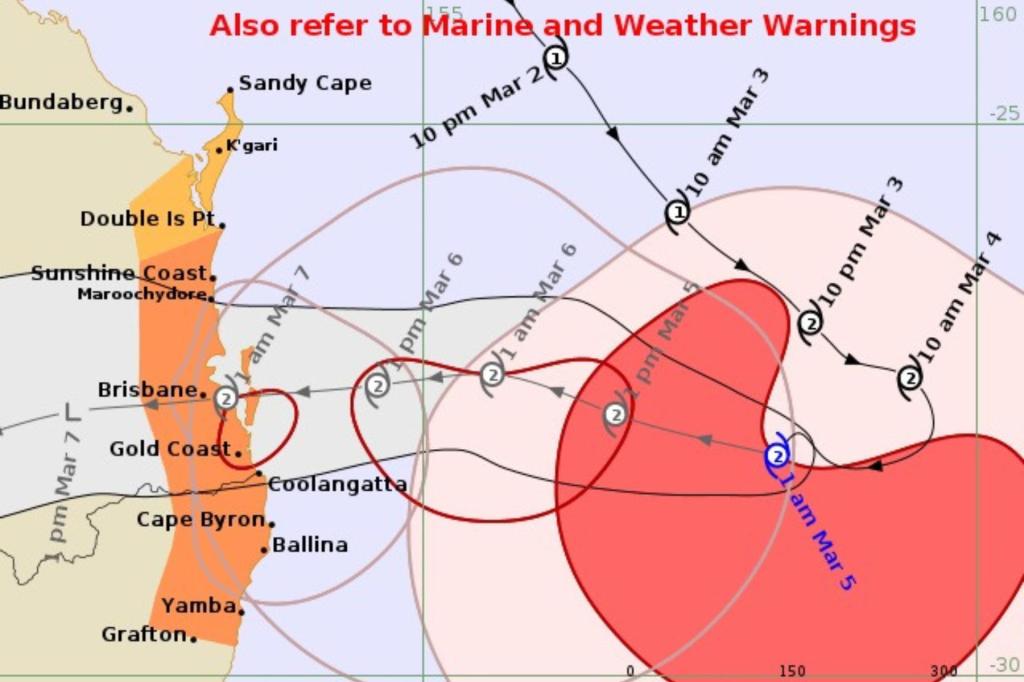
Early on Wednesday, Alfred was about 465 kilometres east of Brisbane. It is packing wind gusts of 130km/h as it travels westwards at about 11km/h.
“Alfred is a category two cyclone and is forecast to maintain this intensity as it approaches the south-east Queensland coast on Thursday,” the Bureau of Meteorology said.
A warning zone stretches from Double Island Point in Queensland to Yamba in NSW, with Alfred forecast to make landfall on Thursday or early Friday.
Flash flooding, heavy rainfall, destructive winds and storm surges will follow, as south-east Queensland faces its first cyclone direct hit in 50 years.
The worst of Alfred’s land impact is expected in Brisbane, the Gold Coast and NSW’s northern rivers – which is still recovering from deadly floods three years ago.
Prime Minister Anthony Albanese has touched down in Brisbane, as the federal disaster response plan activates and a crisis coordination team deploys.
You might like


Queensland Premier David Crisafulli said the cyclone had firmed and urged people to follow the advice of emergency personnel.
“This is a very rare event for south-east Queensland, but it’s not unprecedented, and we are asking you to take it seriously,” he said.
Rainfall totals of 100 millimetres are expected to lash Queensland’s south-east on Wednesday, with up to 400 millimetres by the time Alfred reaches land.
Schools remain open in Queensland on Wednesday but beaches, university campuses and Gold Coast theme parks will close. Ferry services have already been cancelled.
Flights are also likely to be affected.
Emergency services, telco providers and Energex crews have bolstered the region with evacuation centres on the Gold Coast open.
On Tuesday, the AFL rescheduled two season-opening games in Queensland, as golf and surfing tournaments were cancelled.
How to prepare for a cyclone
Your starting point is to consider the risk to yourself and everyone in your household (including pets). Consider ensuring you have:
- non-perishable food that everyone in the family will eat (enough for five to seven days)
- water for drinking and cleaning (three litres per person per day)
- medication (two weeks worth)
- toiletries and first aid kit
- pet food/supplies
- torches
- batteries
- a back up battery for your phone
- baby formula and nappies if needed
- protective clothing and closed-in shoes
- cash in small denominations
- valuable documents such as passports, title deeds, ID, insurance details, photos (these can be photographed or packed in weather-proof container or envelope)
- kids’ books, card games, board games, headphones
- anything else you may need or really value (and isn’t too heavy to carry).
Make sure you have a grab-and-go kit that you can carry by yourself if authorities suddenly tell you to evacuate immediately.
Conventional wisdom used to be to prepare enough supplies for three days of disruption. Now, experts recommend having enough for five to seven days. After the initial disaster, there may be road blockages or supply chain problems.
Ensure you have enough medication for a week or two, because pharmacies may take days or weeks to re-open. And remember that many medications, such as insulin, need to be refrigerated, so consider how you’d keep them cool if the power went out.
Fill containers with water and stick them in your freezer now; they can keep your freezer cool if you lose power. They can also become drinking water in future.
Talk to your neighbours. Do they have a generator or a camping fridge you can use? This is a great opportunity to get to know your community and pool your resources.
Ask yourself if you have friends with whom you or a pet can stay. One of the main reasons people don’t evacuate is because they can’t bring their pets (not all evacuation shelters allow them, so check in advance).
Consider what you can do now to prepare your house. One of the most common call-outs the SES receives is about blocked drains and gutters, so check if there’s time to clean your gutters now. You won’t be able to do it during the storm.
Stay informed – don’t rely on hearsay
Stay informed, daily
Have a plan for getting truthful information before, during and after the cyclone.
Rely on the information provided by official sources, as they will tell you when it’s too late to evacuate or when it’s safe to come out. This is highly context-specific and will depend on where you are located.
Get advice where possible from your local council’s disaster dashboard (most councils have one).
It should provide information such as where to get sandbags, which roads are closed (which can affect your evacuation plan) and evacuation centre openings and locations.
Anyone who monitors social media will see how many amateur meteorologists and maps are out there, but these are often not the best source. Always rely on official sources rather than hearsay, trending footage or amateur “experts”.
Always have a battery-operated AM-FM radio. If power goes out, relying on your phone to track information will drain your phone battery very quickly.
You may be able to charge it via your car or laptop, but telecommunications networks may not be active.
So having a battery-operated radio on hand – and plenty of batteries – is crucial.
What if the cyclone hits while you’re at home?
If it’s too late to evacuate, have a plan for sheltering in place.
Find the smallest room in your house with the least windows (which can shatter in a storm). This is often the bathroom, but it could be under the stairs. It is usually on the lowest level of the house.
Bring your food, water, radio, blankets and supplies there. Avoid walking around the house during the cyclone to fetch things; there could be glass on the floor or debris flying around.
It’s hard to predict how long you will need to shelter there, but it’s important not to leave until official sources say it is safe to do so.
Cyclones come in stages. They arrive from one direction, then comes an eerie calm as the “eye of the storm” passes over. Next, the other half of the cyclone arrives. Don’t go outside during the eye of the storm, because it’s not over.
Outside the house, there may be powerlines down, broken glass and other hazards. Don’t venture out until you get official clearance from the disaster dashboard or official sources on the radio saying it is safe.
For non-life threatening emergencies – such as a tree on your roof, or water running through your house – call the SES on 132 500 or register on the SES Assistance app (if you’re in Queensland). They will not come during the event itself but will come later.
If it’s a life-threatening emergency, always call triple 0.
After the storm
After the storm, consider how to make your house more cyclone-ready in future. Many houses in North Queensland are designed for cyclone zones, but not as many further south will be.
Climate change means cyclones are likely to be more severe in future. These days, be cyclone-ready 365 days a year.
Yetta Gurtner, Adjunct senior lecturer, Centre for Disaster Studies, James Cook University
This article is republished from The Conversation under a Creative Commons license. Read the original article.
Want to see more stories from InDaily Qld in your Google search results?
- Click here to set InDaily Qld as a preferred source.
- Tick the box next to "InDaily Qld". That's it.


