Not a Trump acolyte in the strictest form, but Dutton making a good fist of it
In one of their typically literary sketches, 1990s comedy duo Stephen Fry and Hugh Laurie asked if Adolf Hitler’s fanatical racist oratory would have been as charismatic if delivered in English. Mark Kenny reports
It’s a joke that has no answer, of course, but there is little doubt that national characteristics including history, public debate and electoral institutions have framed the way politics is discussed in notionally open societies.
Political actors venturing beyond these informal boundaries have courted controversy and opprobrium. Transgressions could be career-ending.
But such limits have never been entirely static and may now be tumbling entirely as the failures of neoliberalism and globalism feed a widening distrust in old orthodoxies.
Increasingly, high-profile nationalist and populist movements in many countries are making a virtue of eschewing the usual etiquette of politics in favour of divisive hyperbole.
In the digitised global media age, these nativist forces can also cross-pollinate.
Within New Zealand’s Luxon coalition government, for example, far-right support for rolling back Maori rights under the Treaty of Waitangi takes encouragement from Australia’s refusal to recognise First Nations Peoples in the Constitution.
In two Australian states in the past few weeks, (South Australia and Queensland), ultra-conservative Liberal MPs have been associated with attempts to re‑criminalise abortion.
The revival of an incendiary debate that had largely been settled in Australia felt like it came from nowhere. In fact, it probably came from post-Roe v Wade America.
Such is the reach of an abrasive populism paraded by Donald Trump, who now openly describes his opponent, Kamala Harris, as “a shit vice president”.
You might like
Trump’s very viability as a Republican presidential candidate – which seemed unthinkable when he fomented a deadly insurrection of the US Capitol in 2021 – has shown polite norms and even long-established laws can be made politically contestable. This even extends to the outcomes of elections themselves.
In several democracies, Trump’s reprise, and his belligerent contempt for the constraints of “elite” process, looks to have inspired a disruptive new political brashness. Examples include Britain (Nigel Farage’s Reform), Austria (Herbert Kickl’s far-right Freedom Party), Germany (AfD), France (Marine LePen’s National Rally), Argentina (radical libertarian president Javier Milei) and, arguably, Australia.
Things are milder in Australia, so far.
Australia’s institutional democratic architecture – compulsory preferential voting, Westminster parliamentary traditions and the Australian Electoral Commission (AEC) – exerts a moderating influence on political discourse. Successful competitors have usually focused their efforts on winning across the middle ground.
But, as the primary vote share of the major parties falls, new electoral opportunities are burgeoning on the fringe.
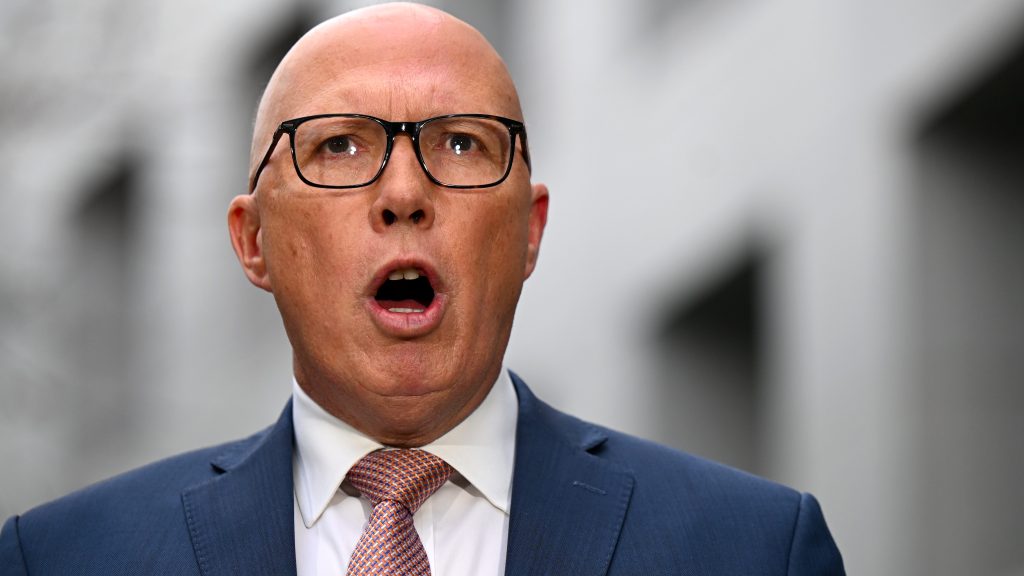
Since his elevation to the leadership of the Liberal Party, Dutton’s pitch to voters – including those his party surrendered to centrist community independents in 2022 – has nodded less towards the middle than to a disaffected outer-suburban cohort traditionally cleaved to Labor.
Like Trump, whose support base is essentially white working class, Dutton seems to be forgoing the inner cities to chase suburban and regional malcontents. This includes blue-collar voters disillusioned with institutional politics and alienated by what Dutton perceives as Labor’s elite cosmopolitanism and capture by “woke” politics.
Also like Trump, Dutton employs intimidation to dissuade “woke” CEOs and “mad left” journalists at the ABC and The Guardian.
Central to Dutton’s suburban strategy is a Trump-style contempt for institutions and “elite” nuance.
Even the AEC, widely regarded as among the most trusted bodies in the country, was fair game for Dutton during the Voice referendum debate. In the lead-up to the referendum he suggested it had “rigged” the contest in favour of the “yes” case.
Just make it a fair process instead of trying to load the system and trying to skew it in favour of the “yes” vote.
In the place of moderation comes strident us-and-them positioning. Dutton proposes to solve the climate and energy policy challenge with a radical and expensive nuclear pivot. This is designed to discredit Labor’s “ideological” renewables investment program and relieve the Coalition of culpability for decades of climate change denialism and inaction.
Stay informed, daily
Buoyed by the defeat of the Voice referendum and frontal attacks on big business, Dutton appears to be hardening as the next election nears.
He buttresses steep immigration cuts with rhetoric implicating migrants for causing high housing costs, traffic congestion, long GP waiting times, rising crime rates and social disharmony.
Last Thursday, he confirmed that under his prime ministership foreigners and temporary residents would be prohibited from buying existing homes for two years.
He said “Australians” were being “outbid”.
“It’s a situation many first homebuyers are facing right now,” he said via a post on X. “It’s simple, we’ll make sure homes are available for those who need them most, Australians”.
Subtlety is not one of Dutton’s tools of trade. He invokes a moral clarity in expressing unconditional support for Israel, for example, while rarely acknowledging the massive losses of Palestinian and Lebanese life.
Such is his absolutism that he withdrew the customary bipartisanship over the government’s parliamentary condolence motion for the victims of October 7 2023.
Meanwhile, he calls for pro-Palestinian demonstrators to be arrested for displaying flags, despite the law being directed at prohibiting incitement, rather than at preventing political expression.
On China, Dutton depicts the Albanese Labor government as too “weak” to stand up to Beijing or prepare for a potential fight. He told Nine’s Karl Stefanovic in 2022:
“The only way that you can preserve peace is to prepare for war and to be strong as a country, not to cower, not to be on bended knee and be weak.
Taken together, Dutton’s bullish oppositionism blends the uniform aggression of Tony Abbott with elements of defiant Trumpism. This has included attacks on individual journalists, and a preference for friendly media interviews outside the capital.
Polls in Australia present a confusing picture. On the one hand, Australians are wary of a vengeful and mercurial Trump. Only one-in-five Australians in a recent Nine newspapers poll favoured the Republican as the next US president.
On the other hand, around half of all voters polled seem to prefer a Coalition government that, under Dutton’s leadership, has moved markedly to the right.
In common with the American, Dutton’s gathering boldness may be a large part of his attraction. In an attention-fractured electorate, competent procedural administration struggles to outshine the headline-grabbing clarity conveyed by strong language and simple solutions.
Whether it is campaigning against Indigenous crime in Alice Springs, advocating court action and even divestiture of the big grocery retailers, or demanding absolute and unqualified loyalty to Israel, Dutton speaks in straight lines, his rhetoric base and visceral.
The 2025 election will be fought on cost of living and the government’s limited success in protecting ordinary voters.
Dutton is harvesting voter anguish and mounting cynicism about the efficacy of measured line-and-length politics to make any headway against persistent problems.
In short, Trumpism with Australian characteristics
Mark Kenny is Professor, Australian Studies Institute, Australian National University. This article first appeared in TheConversation and is republished here under Creative Commons Licence.
Want to see more stories from InDaily Qld in your Google search results?
- Click here to set InDaily Qld as a preferred source.
- Tick the box next to "InDaily Qld". That's it.