What a pair of Chalmers: Why these two men have more in common than you might think
Treasurer Jim Chalmers wound up the rhetoric for an old fashion whack at the Opposition Leader this week. It brings back memories of a previous Labor attack dog, writes Michelle Grattan.
Is the Albanese government trying to cast Opposition Leader Peter Dutton as Australia’s Donald Trump? And if so, what’s the thinking and why is Treasurer Jim Chalmers in the vanguard of the charge?
Delivering the Curtin Oration this week, Chalmers said Dutton was “the most divisive leader of a major political party in Australia’s modern history – and not by accident, by choice”.
“He divides deliberately, almost pathologically. This is worse than disappointing, it is dangerous. His divisiveness should be disqualifying.”
On any reading, this is extreme language – especially coming from Chalmers. In question time, the treasurer doesn’t mind launching cutting barbs against opponents, but he usually refrains from going over the top.
As Chalmers’ attack appears to spray-paint Dutton with a coating of Trumpism, is this the politics of defence from a government feeling embattled, as much as it is the politics of offence?
In the past couple of parliamentary weeks, Dutton was criticised by some commentators for concentrating on the issue of visas for Gazans. Surely, the argument ran, he should have been talking about the cost of living, which is what most Australians primarily care about at the moment.
You might like
Chalmers said in his speech: “Every question in question time last week was about the Middle East, and not one about middle Australia”.
But if the Coalition had themed the cost of living in question time, it would actually have given the government more chance to talk about its tax cuts and other budget relief (which, incidentally, it is promoting shamelessly in government-authorised, taxpayer-funded TV advertisements – Labor in opposition once criticised that sort of spending).
An important clue to Dutton’s thinking came in Tuesday’s Essential poll, published in the Guardian. It showed that 44% agreed with the opposition leader’s call for a pause in the intake of Gazans. Just 30% opposed it and 26% were undecided. Whatever one might think of the Dutton stand – which lacked nuance and compassion – it clearly hit a political nerve.
On another front, Saturday’s sweeping Country Liberal Party victory in the Northern Territory election doesn’t have direct federal implications, but Dutton would take some heart from it in relation to his own strategy. The new NT government won on law and order, an issue that’s a first cousin to the national security and visa concerns Dutton is seeking to exploit.
In casting Dutton as apparently Trumpian, the government might also be noting the current mood change in United States politics.
Kamala Harris’ presidential candidacy has swung the emphasis on to unity, positivity and “joy”. It has not just left Trump floundering (at least for the moment), but re-emphasised his divisiveness and the potential risks he poses.
Stay informed, daily
At present, two things are happening simultaneously between the government and opposition. There’s more deal-making on substantive policy (notably on the NDIS and aged care) than at any time since the election of the Albanese government. At the same time, the attacks on Dutton are intensifying.
Chalmers is working to clinch an agreement with shadow treasurer Angus Taylor on more reform of the Reserve Bank. Meanwhile he is amping up the assault on the opposition leader to number 11.
The positive side of Chalmers’s speech was overshadowed by the barrage against Dutton, yet Chalmers is at his best when he is constructive.
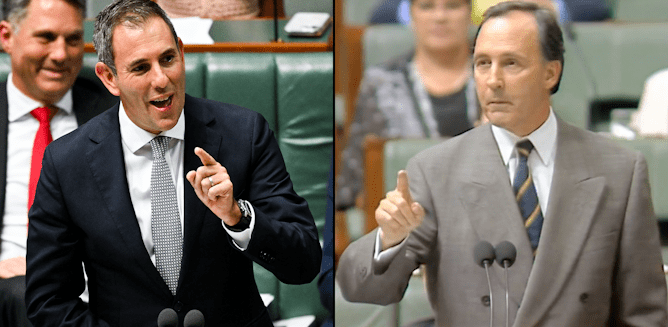
When he’s in full attack mode, he sounds more than a little like Paul Keating. (From a distance, he even looks like him.) Chalmers has studied, forensically, the man who was treasurer and then PM. His PhD thesis at the Australian National University was titled “Brawler Statesman: Paul Keating and Prime Ministerial Leadership in Australia”.
In it Chalmers wrote: “Keating employed numerous strategies in parliament. He sought to differentiate Labor from the Liberals and discredit the Opposition with slick put-downs and by listing the achievements of the Keating (and Hawke) Government. […] He sought to paint the Liberals and Nationals as out of touch and not up to the task, highlighted internal dissension in the Opposition and pointed out the limited capacity of senior shadow ministers.
“His tone varied from sarcasm to contempt to enthusiasm for new initiatives, but the intensity of the attacks and the disdain for what he saw as an Opposition incapable of leading the country was consistently evident throughout.”
It was a style Keating displayed both as treasurer and prime minister.
In an interview with The Australian’s Troy Bramston, published last weekend, Keating described how he saw himself: “In politics, I was in the blood and gore business, fundamentally. But with big ideas always running it.”
As Anthony Albanese loses the shine he had before and immediately after the 2022 election, and anyway lacks razor sharpness, Chalmers as attack dog may be useful for a government on the back foot. But if this becomes his longer-term image, how good that will be for the man aspiring to be prime minister might be questioned.
In government, attack dogs can be popular with the journalists, who love the sport. But often not so much with the public. In 1993 Keating won an unwinnable election as attack dog par excellence but by 1996 it was another story.
Michelle Grattan is professorial fellow at the University of Canberra. This article first appeared in The Conversation and is republished here under Create Commons Licence
Want to see more stories from InDaily Qld in your Google search results?
- Click here to set InDaily Qld as a preferred source.
- Tick the box next to "InDaily Qld". That's it.