Away from the Open glare, another storied tennis career fades sadly away
While the Novak Djokovic cloud loomed large over the Australian Open, another troubled soul moved quietly into and swiftly out of the Open pre-qualifying. So, what ever became of Bernard Tomic, asks Michael Blucher
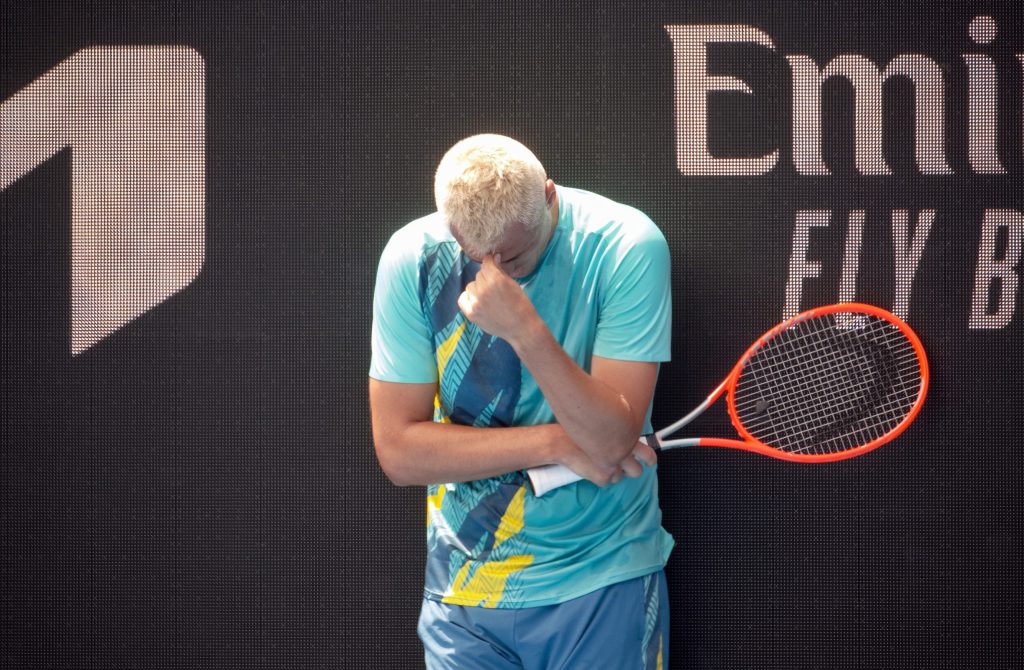
On the safe assumption that you’ve read more than enough about “No-vax” Djokovic over the past three weeks, let’s check in briefly, shall we, on another of the sport’s favourite punching bags, Bernie.
Wait. Before you drop-volley me out of your browser, let’s be quite clear. This is not another “kick Bernie Tomic to the kerb” exercise where we pick to pieces all the recent outlandish things that he’s said and done.
Granted… “I can still win WImbledon, I will one day, that’s for sure” – that was a doozy. But you have to remember, after Kevin Rudd was rissoled in 2010, he told anybody who’d listen he’d be Prime Minister again one day, And not even Therese gave that a hope in hell.
No, rather than ridicule, it’s time we delve a little deeper.
On the assumption that we can learn as much from falling short in life as we can from flying high, what might we glean from the turbulent on-court career of Bernard Tomic?
Casting aside for a moment the vitriol of all the haters and the keyboard warriors, firing blanks into thin air, what are lessons worth banking?
First set point – time passes quickly.
If you can you believe it, Bernie has been on this crusade now for 15 years – he’s been teasing us with his talent since he first appeared on the tennis scene back 2006.
You might like


It seems only a year ago, I was speaking to the bloke who took Tomic on his first overseas trip as a junior. They were off to play in Europe some somewhere.
By the time the squad stopped over in Singapore, the team manager was done. He rang Tennis Australia in Melbourne. “I’m cooked,” he said. “This kid’s a friggin’ nightmare.” But that was 2005.
As hard as it might be to reconcile, Tomic is now 29 years of age – he turns 30 in October.
There’s another reminder – a second set point: In life, we only get a limited number of cracks at getting it right. After that, the genuine supporters, the true enablers, drift away. They lose interest and patience, allocating their efforts instead to high potential prospects who are more coachable and appreciative.
Another set point – hard work and persistence eat natural talent for breakfast. The sporting world is chock-a-block full of precociously gifted individuals, but talent only takes them so far. As a wisened sports physio who works with countless elite athletes reminded me just this week – “the equation isn’t talent + hard work = success, it’s talent x hard work”.
Set point No. 4 – you’re only as good as the company you keep. And it’s within this realm that Bernard Tomic deserves our strongest sympathy.
He never stood a chance.
Instead of being guided and supported by his tyrannical father, he was ruthlessly controlled. He didn’t speak, he didn’t think for himself. From the age of four, he just listened and did what he was told.
Think of the stuff that went on early in his career – for instance Tomic’s “entourage” telling Lleyton Hewitt at Wimbledon that he was “not good enough to hit up against” his then 16-year-old countryman. The 2002 champion, not worthy? How do you think that went down? Talk about an unforced error.
Yet teenager Tomic clearly had no say in the matter. He played no part – it was his father’s bizarre call. My Bernard will be World No 1. He will win 10 Grand Slams.
At one level, this singular, obsessive focus might have been admirable – John Tomic wanted nothing more than Bernard to be the best, to fulfil “their” aspirations.
Stay informed, daily
But it was never going to end well. The pressure and expectations placed on the boy from the earliest of ages was unfathomable.
Former tennis (and golf) professional Scott Draper, picked it very early.
In his high performance role at Tennis Australia, Draper did his best to smooth over the cracks as they widened, but it became fruitless. The cracks became crevices.
“Any relationship based purely on fear is never going to last,” Draper said of the dynamic between father and son. “Bernard will reach the point where he’s no longer afraid of his father. And then it’s all over. If the aspirations aren’t his, he won’t care about the results.”
Far too early, that’s exactly what happened. Tomic deliberately tanked in tournaments, losing matches in record time, probably in private protest of his father’s domineering behaviour and demands. Who knows – other than Tomic himself.
Now, in the blink of eye and the twirl of the racquet, Bernie is approaching 30. Relatively speaking, he’s one of tennis’ “seasoned veterans”, entering the twilight years of his professional career.
Tomic has been MIA from the game over the past few years, apparently trying to resolve who he is as a person, and what’s important to him, now that it’s his decision, not his father’s.
He’s once again talking a good game. A great game. Winning Wimbledon – the goals don’t get any more audacious than that.
But as he apparently needs reminding, a goal without a plan is nothing more than dream. Similarly, words and actions deliver markedly different outcomes.
Bernie has said he wants to retire “guilt free” – in other words, eventually leave the game having fulfilled some of the enormous potential he’s always been known to have.
For his own sake, nobody else’s, let’s hope he can achieve through tennis some level of inner peace.
Sadly, the odds now appear stacked against him.
For all Bernard Tomic might have achieved in an environment of encouragement rather than fear, it looks for all money like he’s locked himself out of the Grand Slam arena for good.
Game, set, match.
Footnote: A Covid-riddled Tomic last week lost in the first round of qualifying for the main draw of the Australian Open.
Want to see more stories from InDaily Qld in your Google search results?
- Click here to set InDaily Qld as a preferred source.
- Tick the box next to "InDaily Qld". That's it.



