Whatever it takes, and then some more for good measure
It’s been a sobering week for the Prime Minister in his attempt to minimise some of the financial damage of the pandemic, and also being put back in his box by an unlikely figure, writes Michelle Grattan.
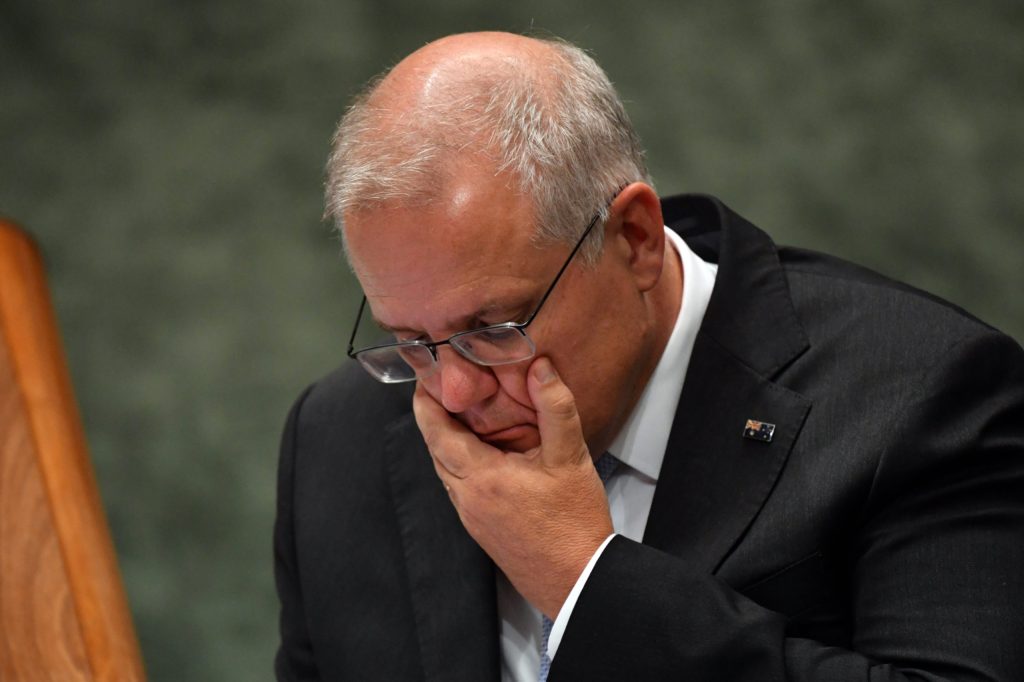
Scott Morrison operates on former Labor powerbroker Graham Richardson’s well-tried “whatever it takes” principle.
“What it takes” in the COVID era is never-ending public money and policy flexibility. We’ve seen both from the Morrison government.
It also takes highly competent implementation, of which we are not seeing enough at the moment.
This week Morrison tried to hold out on giving assistance to Victorians, hoping the state’s latest lockdown would last only seven days. He didn’t want to provide what he regards as encouragement for shuttering.
But with the extension of the closure in Melbourne, the prime minister had to capitulate. He went out of his way, however, to insert as much federal control as he could, with a “temporary COVID disaster payment” that will go to affected workers in a “hotspot” identified by the Chief Medical Officer under the Commonwealth definition.
This will apply in any state when lockdowns last beyond a single week. While there’s no dispute between the CMO and the Victorian government that Melbourne is at present a “hotspot”, if a federal-state difference arose in future, the federal rule would apply.
Morrison might be furious at Victoria’s caution in managing COVID, very different from NSW’s less restrictive but effective approach. But, as the PM has been reminded so often during this crisis, the premiers (or in Victoria’s case the acting premier) have the say. And it’s no good bitching about them, because the “quiet Australians” don’t like such fighting.
Meanwhile the government is dipping into the till to finalise a deal on a stand-alone quarantine facility near Melbourne. This is just weeks after senior cabinet minister Peter Dutton dismissed Victoria’s plan as “political smoke and mirrors”.
It will be some days before it’s clear whether Victoria is on top of the present outbreak (which originated in South Australia). A frightening development came when it started to touch nursing homes – so far, thankfully, exposure has been extremely limited.
You might like
But politically, the Morrison government this week has had maximum and very negative exposure on aged care, which is its responsibility.
Not only was parliament sitting but the Health Department had two days before a Senate estimates committee, occasions that leave most news conferences for dead when it comes to applying heat to feet.
Aged Care Services Minister Richard Colbeck received yet another doing over, as did Health Department Secretary Brendan Murphy. Colbeck couldn’t say how many aged care workers have been vaccinated. Murphy was quizzed (among much else) on Morrison using him as a shield for the PM’s unfortunate “it’s not a race” line.
In question time in the House, Health Minister Greg Hunt had to admit to getting a key number wrong.
The various interrogations added to the existing picture of a rollout that’s been, and continues to be, shambolic.
It was always going to be difficult. But among the many issues, there is no excuse for the aged care tardiness and other failures (and it’s worse in the disability sector). And why chemists haven’t been accelerated into the general rollout remains a mystery. Anyone who has a flu shot knows it’s quicker and easier to get it at a pharmacy than go to a doctor.
Although Morrison is very aware that in the pandemic it is never a good time to leave the country, he regards the G7 meeting, to which Australia has been invited, as a top priority, not least because it will enable his first face-to-face meeting with Joe Biden since he became president.
With fingers crossed, Morrison departs for Britain next week, travelling via Singapore and leaving Michael McCormack as acting PM, which carries the risk of a foot-in-mouth outbreak. The PM will miss part of the next parliamentary fortnight and be on remote (in quarantine) for the rest of it.
The government will endure a lot of political pain over the rollout for months to come. But by early next year the job surely will be more or less done, though a portion of the population will remain, for one reason or another, unvaccinated. Will what’s happening – or not happening – now be affecting Morrison’s fortunes then?
Assuming the virus does not in coming months erupt into a big new wave – and those cautious premiers are the best protection against that – Morrison may have shed much of today’s rollout baggage by then.
He told his party room again this week the election would be next year. We know from 2019 it’s unwise to predict results. But the underlying conditions at the moment set Morrison up well.
No state or territory leader has lost an election since the pandemic started. Apart from governments’ success in containing COVID, people are wary of change in these uncertain times.
Stay informed, daily
This week’s national accounts reaffirmed the economy is recovering strongly (1.8% growth in the March quarter, 1.1% annual).
And, although its COVID attack is sharp and to the point, the opposition is weak at a more fundamental level. Anthony Albanese is still struggling to make his mark, and Labor has serious policy dilemmas, including on climate and energy and its stance on the 2024-25 legislated tax cuts.
For many voters, the opposition’s “story” is not, at least at this point, a compelling read. Nor is it obvious how it can make it so.
Despite the pressure he and his government are under on the rollout, Morrison has a united team behind him (with one notable qualification – he’s constrained on climate and energy policy, these days mostly by vocal Nationals outriders).
Given the extent of Morrison’s authority, the spectacle of him and senior ministers being cut down to size by Speaker Tony Smith in this parliamentary fortnight was all the more arresting.
Smith has been an impressive, fair-minded speaker, but the House’s question time has remained unruly, and ministers have babbled on rather than addressing the questions asked by the opposition.
Smith suddenly decided to up the ante, cracking down on the chaotic behaviour from both sides, and forcing discipline on ministers. The latter came as an unpleasant shock to Morrison, Hunt, Treasurer Josh Frydenberg and other frontbenchers.
Morrison was humiliated last week in an exchange after Smith insisted he be relevant to the question. “I’m happy to do that, Mr Speaker,” Morrison said, to which Smith snapped back, “I don’t care whether you’re happy or not.”
“Okay,” said a startled PM.
For an instant, Morrison found he wasn’t the most powerful person in the room. It was a character-building moment.
Smith told the House on Thursday: “Obviously in the course of the last week I’ve enforced the standing orders vigorously. I intend to keep doing that.”
The reason, he said, was “to get an improvement in parliamentary standards”.
Some old hands on the Liberal backbench have been stunned at the length to which Smith has been willing to go. They recalled the fate of the late Bob Halverson, who became speaker after the election of John Howard in 1996, only to be pushed out of the position two years later because the government thought he was too impartial.
Smith is not at any immediate risk of such a fate. But what about after the election if the government is returned?
Smith’s commendable courage suggests he thinks one of two things. He judges his position is secure as long as he wants it and the Coalition is in government. Or he believes the cause is important enough to say to hell with the consequences.
Michelle Grattan is a professorial fellow at the University of Canberra and chief political correspondent at The Conversation, where this article first appeared.
Want to see more stories from InDaily Qld in your Google search results?
- Click here to set InDaily Qld as a preferred source.
- Tick the box next to "InDaily Qld". That's it.