Retired GP spends months trying to save a single platypus
Ian Gibbs didn’t hesitate to take a few snaps when he spotted a platypus on one of his nature walks. When he examined the photos later, he knew something had to be done.
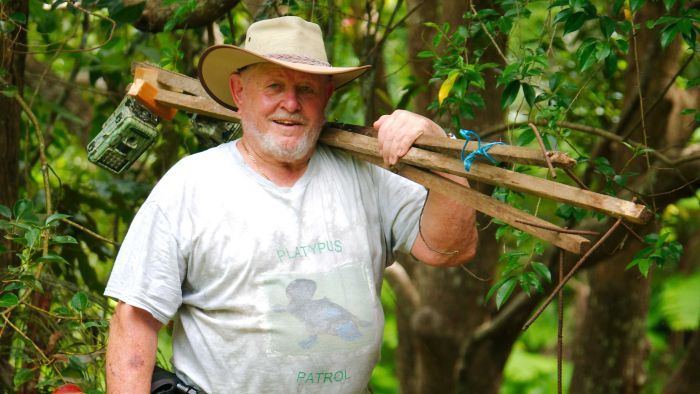
A chance encounter with a platypus in a Far North Queensland creek has led the retired GP on a months-long quest to free it from its plastic bonds.
Gibbs, 79, spotted the monotreme in December 2020 during one of his frequent walks along Peterson’s Creek, southwest of Cairns on the outskirts of Yungaburra.
“It was rolling around and scratching various areas of its body, so I took a number of photographs,” Gibbs said.
“It wasn’t until I got home and put the pictures on the computer … that I realised that it had what looked like a plastic band around its neck.”
Concern for the animal’s wellbeing compelled Gibbs to post his pictures online and seek advice from other wildlife enthusiasts.
“Eventually the Department of Environment and Science got involved and actually sent a team up here to try and catch the platypus so we could remove the ring,” he said.
You might like


“Unfortunately after a couple of days they weren’t successful and since then I’ve been trying to find out where its burrow is so we could have more chance of catching it on another occasion.”
To save himself or anyone else the monotony of sitting beside the creek for hours on end, Gibbs borrowed a set of camera traps from a local wildlife group.
“They have a sensor which operates from infrared light — it detects the difference in temperature when a warm-blooded animal moves against the background,” he said.
“Unfortunately, platypuses have an abnormally low body temperature, and their fur is often wet, which means that it’s often an even lower temperature.
“The cameras can’t record them because they can’t see them.”
Having learnt from his failed attempts to photograph platypuses in the creek, Gibbs has taken to setting up his cameras over what he suspects to be their burrows.
Stay informed, daily
Supported by tomato stakes, some with a homemade hinge mechanism allowing for the camera angle to be altered, each trap points directly at the muddy openings that dot the bank.
“At the time the platypus emerges from its burrow it should be dry and there should be a greater contrast between the temperature of the platypus and its surroundings,” Gibbs said.
“But as yet, I haven’t had any positive results.”
For nearly two months Gibbs has traversed the banks of Peterson’s Creek setting up five cameras in a variety of positions.
Some days he spends as many as four hours walking the creek bank, uploading and inspecting photographs and recording what he sees.
“I suppose I’m a bit of a technology nerd,” Gibbs said.
“I got my first computer about the time the first Apple computers came out and I think I’ve never been without a computer since.
“So when I get the chance to go and try something new I tend to go and have a go at it.”
Until it is either proven conclusively, he cannot photograph the platypus with a camera trap, or he succeeds in tracking down the entangled animal, Gibbs says he will not stop.
“I’ve always thought that if a job’s worth doing it’s worth doing well,” he said.
“Having sort of initiated this and being on the spot I personally feel some obligation to try and bring it to a satisfactory conclusion.
“My wife’s beginning to think she’s a platypus widow.”
– ABC / Mark Rigby
Want to see more stories from InDaily Qld in your Google search results?
- Click here to set InDaily Qld as a preferred source.
- Tick the box next to "InDaily Qld". That's it.



