Gold Coast students link with Dubai to design sustainable city
As the world went into lockdown in March last year, a group of young St Hilda’s school students on the Gold Coast worked with their counterparts in the United Arab Emirates to design a sustainable city of the future.
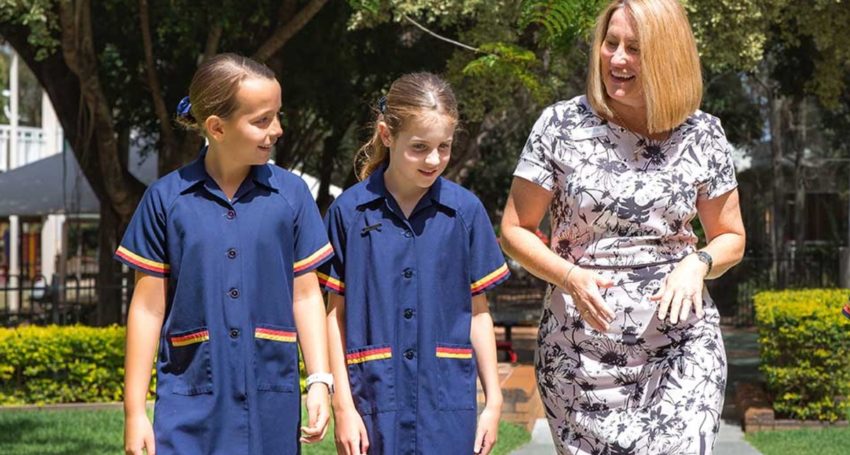
About 22 Students from St Hilda’s have been collaborating on the Future Cities project with a team of 35 students from GEMS International School in Dubai since the beginning of this year.
The program, designed to give the students a global perspective on the sustainability issues impacting humanity, has evolved into an exercise in discipline and resilience amid the fluid challenges of 2020.
While the Future Cities project was always intended to be mostly conducted online, in a normal year the two teams would have already met in Dubai to jointly reveal their findings via a multi-modal presentation, including a 3D concept model, in front of an international audience at the World Expo 2020.
This year’s expo was scheduled to attract exhibitors from 76 countries over six months between October to March. Due to COVID-19, the World Expo has been postponed until October next year and the students will take the opportunity to continue refining their research project in the first term of 2021.
Amanda Shuttlewood, Head of St Hilda’s Junior School, says the challenges of remote learning during COVID-19 did nothing to dampen student enthusiasm for the project.
“Younger students adapted very quickly to online learning and collaborating, which demonstrates that they don’t see barriers in this at all,” Shuttlewood says.
“While they may have missed the social aspect of being at school, seeing their friends and connecting with their teachers, they were able to seamlessly move into the online world and keep their lessons going. The students had to quickly embrace the changes we put in place and they adapted quite quickly to the way we had to run the program.”
You might like


Considering the challenges, perhaps it’s the age of the students participating in the Future Cities project that is most impressive. They are all from Years 3, 4 and 5 – aged from eight to 10.
The focus of Future Cities is on sustainability where the students are asked to design and develop a city of the future. That includes everything from the city’s infrastructure, water management and place management, while also considering the economics of this and the wellbeing of people in the community.
The students work together in research pods gathering data and information about best practice sustainability measures in the fields of climate change, population growth, technology and innovation, infrastructure and economics, as well society and culture.
They work offline at St Hilda’s in groups focusing on their assigned specialist areas and then connect online with their counterparts in Dubai once a week to discuss their progress and prepare for future tasks.
“These are big concepts for primary aged children to be tackling and they actually enjoy the challenge,” says Shuttlewood.
“It involves a lot of creative thinking, problem solving and organisational skills, and provides our students with an opportunity to learn aspects of sustainability from a truly global perspective.
“They are dealing with young people who face different sustainability issues in Dubai than we do here, and at the same time they are learning about the issues we all have in common and need to overcome.
“Certainly, the experiences of the Dubai-based students are educating our students, but we are equally educating them, so it’s very much a shared experience.”
Stay informed, daily
The opportunity to participate in the Future Cities project and to collaborate with GEMS International was presented to St Hilda’s through the efforts of Study Gold Coast, with support from the City of Gold Coast, Trade and Investment Queensland and the Department of Foreign Affairs and Trade.
Also playing a key role is the Gold Coast’s 23-year sister city relationship with Dubai, which has become a source of economic, cultural and educational collaboration between two world-class, dynamic cities since 1997.
“The sister city relationship really opened up this opportunity to us when GEMS International was reaching out to make a global connection,” says Shuttlewood.
The relationship has evolved since then and, in October, St Hilda’s was invited to participate in the inaugural GEMS International Schools Conference of Parties Expo (SCOPE) which is dedicated to raising awareness of sustainability issues among future generations. St Hilda’s was the only Australian school to participate in the event.
“Our students were able to take part in this conference at an international level, with one of our students invited to speak on the key United Nations goals for sustainability,” says Shuttlewood, who also was invited to address the event.
For all their differences, St Hilda’s School and GEMS International share some common ground, namely a curriculum and culture infused with a global outlook.
St Hilda’s, the Gold Coast’s only all-girl school, was established more than a century ago and has a proud history of international engagement, including a student exchange program with schools in North and South America, Europe and South Africa.
A significant cohort of international students including those from expat families – some of them among the 180 boarders at St Hilda’s – also enhances global dialogue on campus through active social and academic engagement.
The school motto, non nobis solum, meaning ‘not for ourselves alone’, reflects the ethos behind the school’s support for organisations such as Amnesty International and its battle against human rights violations.
GEMS International School is part of the award-winning GEMS Education network. Its student body of 1400 is represented by 89 nationalities, supported by 300 staff charged with delivering an education that meets the needs of a diverse international community amid a rapidly changing world environment.
“As a school, St Hilda’s is heavily focused on developing global links,” says Shuttlewood.
“Our exchange programs with other schools in all parts of the world allow our students to participate in service project work to help international communities develop sustainable practices in schooling and housing.
“Past programs have involved our students representing the school at youth conferences at the UN in New York where they have presented ideas to support global sustainability practices.
“The Future Cities program takes it to a different level by creating live classrooms and research groups of students who are not necessarily in the same space, in this case Dubai and the Gold Coast.
“It has allowed us to open the classroom to be more global and to bring students together through that online method – and to break down the barriers of international borders.”
Want to see more stories from InDaily Qld in your Google search results?
- Click here to set InDaily Qld as a preferred source.
- Tick the box next to "InDaily Qld". That's it.



