Divers stitch together the foundations of Shute Harbour after cyclone
With marine predators, ocean currents and water visibility impacting work, this is not your average sewing project.
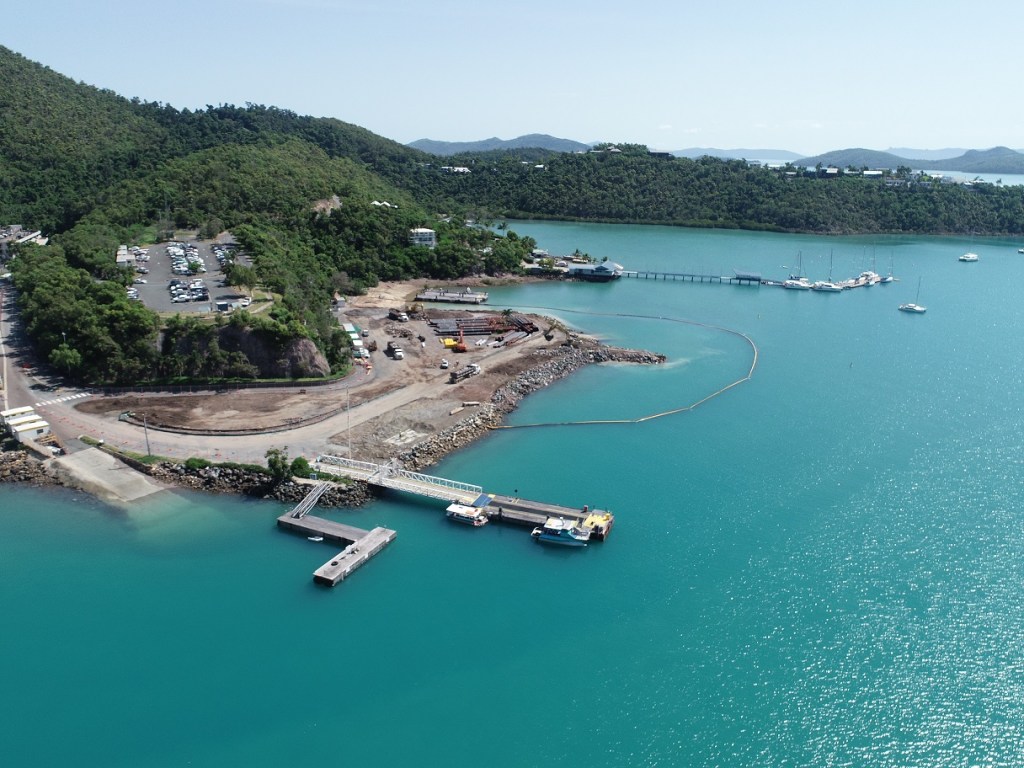
Imagine diving underwater to connect massive sheets of submerged fabric, loop by loop, while you are at the mercy of ocean currents, water visibility and marine predators.
The $54.5 million rebuild of Shute Harbour in the picturesque Whitsundays is a sewing project like no other.
The seawall, pontoons, and site building, near Airlie Beach, suffered extensive damage during Cyclone Debbie in 2017.
The Whitsunday Regional Council said two factors made reconstruction ‘extremely difficult’: tight timeframes, and poor geotechnical conditions.
“Traditionally, with such poor-quality marine mud, you’d have a lot longer to pre-load, consolidate and settle,” Disaster Recovery Project Director, Trevor Williams, said.
“This is a reconstruction of damaged assets. It’s got to be accelerated. That’s why it’s a complicated solution.”
The unusual solution involves joining large sheets of heavy grade ‘geofabric’ in situ, after the material’s been submerged.
You might like


“It is groundbreaking and we’re quite excited it’s progressing well,” Williams said.
Williams said each panel was about 50 metres by eight metres, and collectively, would cover about 9,000 square metres — just over two acres.
“[Geofabric is] used to control the way the marine mud settles when it’s loaded with rock,” he said.
“[The technique] hasn’t been used too much around the world before.
“It’s not a machine under the water or anything like that, and its high current, so it’s challenging for those people doing [the stitching].”
Shark interrupts work
Nick Tyler from Coral Coast Oceaneering, who is managing the divers, said a drone surveyed the site each morning to check for sharks or crocodiles.
“About four weeks ago we had a shark swim past which was estimated to be about three metres,” he said.
Stay informed, daily
“We stopped work for the day and the following morning reassessed the site.”
In other geofabric projects, panels can overlap, but here they have been joined by rope to prevent the particularly poor-quality mud seeping through the rock wall.
“The biggest issue was getting these panels to sit so close tother,” Tyler said.
“If they’re not winched out to the exact spot and we’ve got to move the panels a few metres it would be a tedious task.”
Less run-off to Great Barrier Reef
Initially built in the 1960s, Shute Harbour will have pollution treatment facilities that were not there before.
“There’s a drainage outlet in the middle of the rock wall,” Williams said.
“All the run-off from this area is treated before it goes into the ocean. It’s always just gone in. A lot of Queensland is like that.”
The build, jointly funded by the State and Federal governments, was originally due to be finished in June 2019, but that has been pushed back by two years.
The seawall is 95 per cent complete and construction of the terminal buildings, jetties and pontoons is underway.
– ABC / Angel Parsons and Melissa Maddison
Want to see more stories from InDaily Qld in your Google search results?
- Click here to set InDaily Qld as a preferred source.
- Tick the box next to "InDaily Qld". That's it.



