Could this flappy-armed figure hold key to protecting livestock?
Inflatable arm-flailing tube people are the latest weapon in keeping dingoes away from farms and livestock.
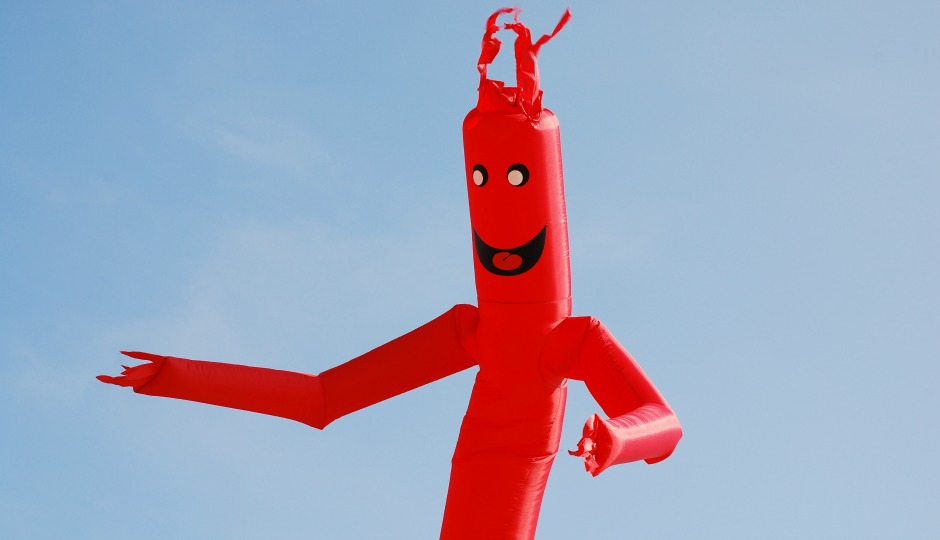
A study led by CQ University psychologist Dr Bradley Smith has found large inflatable people could be used to keep dingoes away from farms in a non-lethal manner.
“‘Because we don’t look after our livestock using shepherds, so humans out there in the paddock,” Smith said.
“We’re missing this kind of human-like figure.
“So we thought why don’t we try the inflatable wavy man, that looks like a person and is quite large and tall and unpredictable.
“Let’s see what happens with that and see if dingoes are scared.”
The study showed the large inflatable devices currently used in car yards and outdoor advertising deterred the animals from accessing food.
While the study was being tested in a captive trial initially, researchers were hoping to take tests to farms across Queensland where dingoes disrupted farming operations.
You might like


Non-lethal alternative
The main aim of the study, according to Smith, was to find a way to have dingoes and farmers live peacefully together.
“Most of the ways we manage dingoes in the wild is by using lethal methods like shooting, trapping, poisoning and what we’re trying to do is search for some non-lethal alternatives,” he said.
“Dingoes are also good for the ecology, for the environment.
“So we want to keep dingoes around for natural balance and order in the ecosystem.”
Smith argued that using inflatable wavy people could be a cheaper alternative to baiting and hiring hunters to track dingoes.
“We spend millions on lethal management,” he said.
“So the device might cost a couple of thousand dollars, but that’s a lot cheaper than man hours and the cost of actually putting out lethal methods.”
Stay informed, daily
Dingoes a vital part of ecosystem
Ecologists were striving to find a way for dingoes and agriculture to co-exist because of the range of benefits the apex predator brought to the ecosystem.
Zoologist Shakira Todd runs a conservation centre where she is rehabilitating native flora and fauna.
She said this new technique would be one tool in the box that would help agriculture and Australia’s native apex predator co-exist.
“If we can introduce predator-friendly farming methods that can benefit the landholder and the environment,” she said.
“You might have guardian animals as well and use [the inflatable people] during a time when predation is more likely, like during lambing.
“Dingoes are generally a 20kg animal, but many countries around the world are managing to co-exist with much larger predators such as cheetahs, lions and bears.
“So we just need to find the balance and how they can co-exist.”
Purity still contentious
Todd said she found debate around dingo purity in the environment frustrating.
“I think there is a big misconception that we don’t have pure dingoes in areas where we have urban development,” she said.
“They are there but they commonly get misconceived as a wild dog, but if they can live in the wild and survive in the extreme conditions of the Australian outback then it has dominant dingo genes.
“If it looks like a dingo, acts like a dingo, then it is a dingo.
“If you took a bunch of alsatians into the outback they might produce a litter, but the likelihood of that litter surviving and reproducing without having dingo genes in it are unlikely.”
– ABC / Ollie Wykeham and Myles Houlbrook-Walk
Want to see more stories from InDaily Qld in your Google search results?
- Click here to set InDaily Qld as a preferred source.
- Tick the box next to "InDaily Qld". That's it.



