Catching lightning in a bottle: Storm chasers shooting for a picture perfect season
In the male-dominated world of storm-chasing photography, these women travel thousands of kilometres across Queensland chasing the perfect picture.
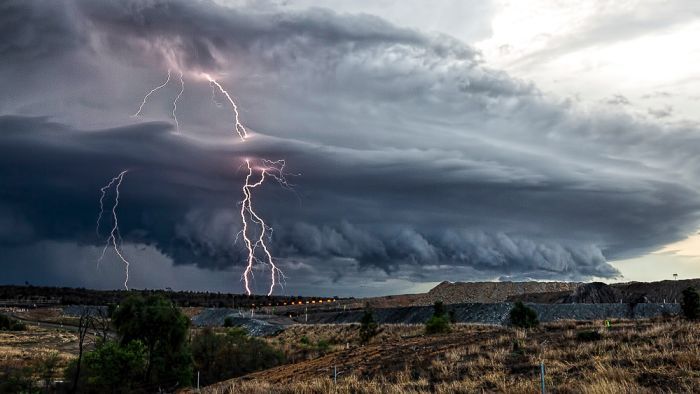
There’s something majestic about the power of an Australian thunderstorm as it amasses extraordinary atmospheric pressure before unleashing its terrifying beauty.
But unless you are in the right spot at exactly the right moment, it’s almost impossible to capture that majesty in a single image.
And, as Sheree Klaproth and Belinda McMahon attest, getting to that perfect vantage point can mean driving for thousands of kilometres chasing a storm as it cuts a furious swathe across Queensland.
The Mackay-based women are among a very small cohort of females in the male-dominated field of storm-chasing photography.
Even though they don’t know each other, both are readying their trigger fingers as the humidity rises in north Queensland and the storm season rolls in.
“I’ve always loved storms since I was really young,” Klaproth said.
“My first storm was a supercell out near Homebush [south of Mackay]. “It was the adrenaline rush that went with it.”
She said it could take hundreds of photographs to capture that one perfect image, but scrolling through them and discovering what she had captured was “part of the rush”. “Lightning is the main reason I love storms. It’s really unpredictable — I think it is really beautiful,” she said.
“Even when you see the lightning, you don’t see the full detail until you see the photograph.
You might like


“The photography brings out the detail your eye can’t see.”
‘It was wild’
Klaproth, an electrician, said to capture a great image, it was essential to get as close to the storm as possible.
“The closer the lightning the better,” she said.
But she said her hobby could be perilous.
She recalled being caught in the path of a particularly wild storm a few years ago in Moranbah, about 150 kilometres south-west of Mackay.
“That did a bit of damage — I didn’t get out of the way quick enough for that one,” she said. “It was wild, there were trees flying past the car.
“I ended up sitting out in the road in my car, in a big open area waiting it out.”
Klaproth said she usually tried to stay ahead of storms, but in the Moranbah incident, she had attempted to photograph the back end of the tempest, and admits now: “That was a bad idea.”
She said learning to read weather conditions had led her to some “amazing moments”.
“I saw my first tornado this year out near Moranbah,” she said.
She had seen a pocket of storm activity on a weather map that looked like it was going to be impressive, so she raced to the location — with her camera at the ready — and arrived just in time. “We saw a supercell there that dropped a tornado for a few minutes,” she said.
Stay informed, daily
She said it took a lot of driving and practice to learn how to track storms.
“I travel thousands of kilometres every season,” she said.
“You learn to read soundings and then, on the day, you drive a lot off road [while] observing what is going on in the sky.”
‘It’s the adrenaline’
McMahon, who has been shooting storms for more than eight years, agrees that it is the thrill of the chase that keeps her going too.
“It’s the adrenaline and chasing the weather patterns,” she said.
McMahon said she had always been interested in the weather, as she had grown up on a farm. But capturing a perfect and stunning image took perseverance and a fair bit of good luck.
“When you get the pic there are high-fives all around,” she said. “It really depends on the wind or conditions. The storm can shift and you might be in the wrong spot.”
Proceed with caution
“It is very male-dominated,” McMahon said about storm photography.
“Personally, I’m more cautious and I hate driving in storms. I’ve never had a close call — that’s where the caution comes in.
“At the end of the day I don’t want it to look dangerous.”
She said chasing storms was often “really hard work” with very little to show for it. “I’ve had a lot of busts, you can come home with nothing,” she said.
McMahon said dedicated storm chasers were prepared to drive for hundreds of kilometres to get the best shot — with some chases often covering more than 800km.
She said it wasn’t uncommon for her to drive several hundred kilometres inland tracking a storm, take photographs, and then drive hundreds of kilometres back home. “Because the area up here is so big, if you want that landscape and that country storm you’ve got to drive,” McMahon said.
“You can have a bumper season where you head out five times a week, or you can go out three times in a season.”
But when that split-second snap captures a freeze-frame moment of storm-made glory, every moment in the car is worth it.
– ABC / Ollie Wykeham and Melanie Groves
Want to see more stories from InDaily Qld in your Google search results?
- Click here to set InDaily Qld as a preferred source.
- Tick the box next to "InDaily Qld". That's it.



