Are we doing enough to keep our aged care homes safe?
First it was Newmarch house in New South Wales, and now outbreaks in Victoria’s aged care sector are a deadly reminder of the risk the virus poses to elderly Australians, particularly in residential facilities.
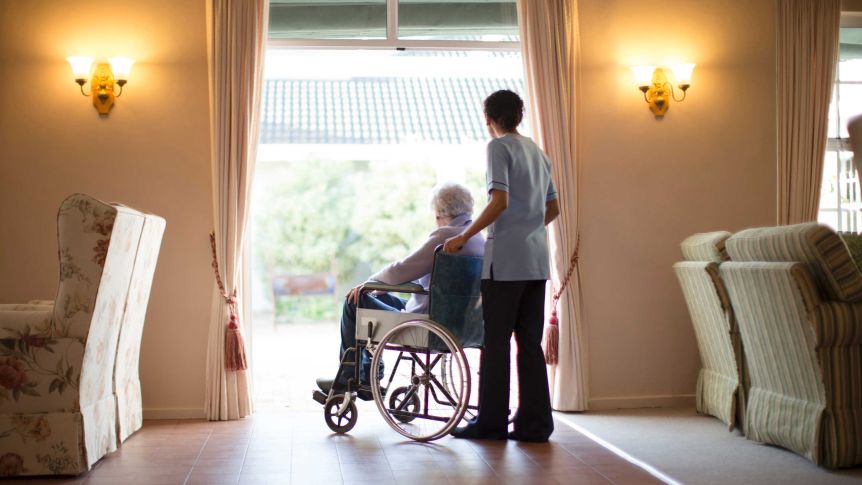
Of the roughly 4,500 active cases in the state, 683 are linked to aged care facilities.
Health officials have made it clear high rates of community transmission mean the virus will find its way into these facilities, but significant work has and is still being done to shield residents as much as possible.
“The residents in these facilities will be people’s parents, grandparents, great grandparents — and they are at a significant risk of dying,” Victorian Chief Health Officer Brett Sutton said.
“That’s an inescapable fact in these settings.”
Here are some of the measures being taken to limit the spread of COVID-19 in aged care homes.
Mandatory masks and visitor limits
According to Prime Minister Scott Morrison, when community transmission is occurring, it is “inevitable” that coronavirus will make its way into aged care homes.
But changes have been made to limit the spread of the virus.
Around the country, a national code has been adopted by aged care providers, governing visitation in aged care homes.

The Federal Government says it is prepared to financially support workers who would usually work across multiple facilities.(Supplied)
It adheres to the latest Australian Health Protection Principal Committee (AHPPC) advice, which says aged care residents should not host more than two visitors at any one time, with visitors not mingling in communal areas.
Deputy Chief Medical Officer Michael Kidd said health authorities were continuing to learn from outbreaks as they happened.
You might like


“We have seen the provision of personal protective equipment, masks, and requirements for aged care workers that they are wearing masks in areas of transmission, whenever they are working with residents, or when providing care to people in their own homes,” he said.
“We have seen the continued working together of different parts of the healthcare sectors, so the aged care facilities working with the Commonwealth, with the Commissioner for safety and equality in aged care, and with the State Government in making sure that we are responding.”
Ultimately, Aged Care Minister Richard Colbeck said aged care homes could not be protected unless COVID-19 was contained.
“The way that we will stop COVID-19 in residential aged care facilities is the same way we will stop it everywhere else in the community, which is by stamping out community spread,” he said.
As concerns of outbreaks in Victoria’s aged care system grow, the state and federal governments have jointly set up a Victorian Aged Care Response Centre, which will operate from Monday.
The decision centralises federal and state government resources to support the sector as cases in Victorian centres grow.
Restricting staff movements
The federal and Victorian governments are currently working with the aged care sector on an arrangement where staff will only work at a single facility, and the governments will pay the wages and entitlements they would otherwise have earned elsewhere.
One of the key issues in the state is that, like in other states and territories, aged care staff usually work at more than one facility, meaning the virus can potentially spread further, faster.

Aged care providers have agreed to a code of conduct for allowing visits to aged care homes.(Supplied: Aged Care Reviews)
Tim Hicks from Leading Age Services Australia, one of the peak bodies for the industry, said more work would be done once the full details of the funding support was worked out, but the idea of getting all staff working at single sites was unrealistic.
“We’ve done a bunch to minimise [people working across sites] since the beginning of the pandemic and even more in the last week,” he said.
“A lot of risks can’t be fully eliminated with COVID-19, we’re trying to minimise them as much as we can.”
Mr Hicks said while providers were on board with the agreement, many people’s livelihoods depended on working across sites, and many businesses would be short staffed as a result of the single site move.
“Talking to our members, something like 20 to 30 per cent of their work force currently work at multiple sites,” he said.
“In the short term we’re going to have all kind of [staffing] gaps.”
Federal Minister for Aged Care Richard Colbeck said last week more than 400 workers from the Government’s “surge workforce” had been deployed to aged care facilities in Victoria to help cover for staff who had to isolate and to support workers to stay at a single site.
Stay informed, daily
But Deputy Chief Medical Officer Michael Kidd said that would not leave other states in short supply of workers.
“Certainly we have surge capacity available right across the country,” he said.
‘No shortage’ of PPE, Government says
A survey released on Monday by the United Workers Union suggested that one in three home care workers did not believe they had adequate supplies of personal protective equipment like hand sanitiser and gloves on site.
The survey was conducted in May and June, before widespread outbreaks took hold in Victoria.
Senator Colbeck said the situation had improved significantly since the survey was taken.

Earlier in the pandemic, some aged care homes were accused of locking down residents too harshly.(Supplied: Elizabeth Lane)
“I reject any assertion that there’s not availability of PPE because I see the numbers, I know what’s available and I know what we’re putting into the system,” he said.
“Going back earlier in the pandemic, there was a global shortage of PPE, and we were making sure that those who needed it had it.
“Now, there is no shortage of PPE, it is being provided into the sector, in fact just the week before last we put 5 million masks into Victoria.”
Of those 5 million, 4 million were sent towards aged care and home care providers.
Victoria’s Chief Health Officer Brett Sutton said he was “not aware of any aged care facility that is short of PPE”.
Calls for people to be moved out early
Mr Morrison said on Monday one of the other federal initiatives being put to use was the deal struck between the private hospitals to help care for elderly COVID-19 patients.
“One of the key things being done in the aged care sector currently is transferring people who have contracted COVID into hospital facilities,” he said.
“We are making use of the private hospital agreement that we put in place some months ago to free up beds.”
Currently, the national health advice for residential care facilities is that COVID-19 patients should only be transferred to hospital “if their condition warrants”.
It also advises that “in some circumstances” it may be feasible to transfer residents who are not symptomatic to other settings, like family care.
But the Chief Executive of Aged and Community Services Australia, Patricia Sparrow, said the current approach should be changed so that all aged care cases were transferred to hospital.
“The state government here has a policy where they are assessing the need to go to hospital on a case-by-case basis,” she said.
“Our position, and what our providers … are saying is that we believe that older people who contract coronavirus should be transferred to hospital, particularly those first cases.
“We have many other residents that we’re responsible for and we think that will help us to minimise the spread within a facility.”
– ABC / Georgia Hitch and Jordan Hayne
Want to see more stories from InDaily Qld in your Google search results?
- Click here to set InDaily Qld as a preferred source.
- Tick the box next to "InDaily Qld". That's it.



