How a small-town Queensland inventor won the hearts of NASA
When NASA called for entries in a competition to design a rover that could potentially explore Venus, Callum Heron drew on his experiences building go-karts and other gadgets in the small Queensland town of Killarney.
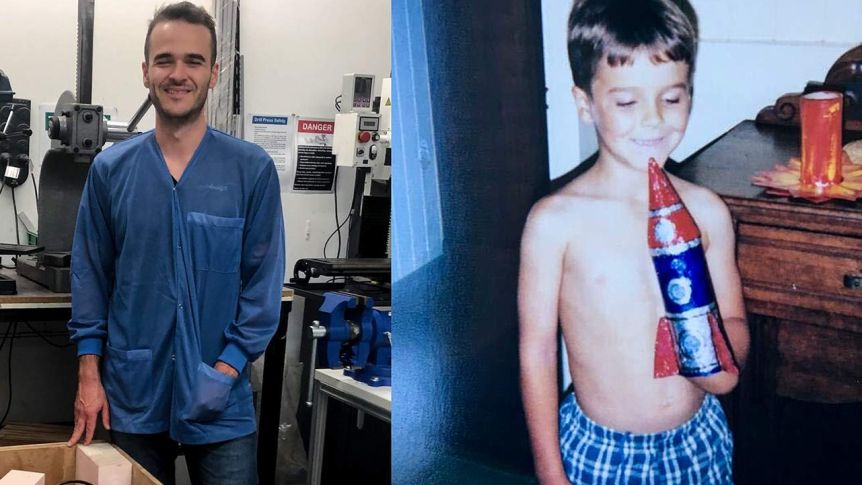
It’s a long way from the farm sheds that surround Killarney in southern Queensland to NASA’s laboratories in the US, but for Callum Heron growing up in a small Australian town has helped shape the way he approaches designing concepts for space exploration.
“We had freedom to muck around and build things and blow things up,” he laughed.
“Having the experience of making things with your own hands, welding up frames, building go-karts, gave us that practical experience that helps me now in my career.”
The mechatronics engineer was named a winner this month in NASA’s crowdsourcing project Exploring Hell, which sought designs for a rover that would potentially explore Venus.
“Venus is fairly similar to Earth in a lot of respects,” Heron explained.
“There’s a lot of comparative science they can do there.”
You might like


Because of the climate on Venus, the rover shares more in common with simple farm go-karts than you might think.
The use of electronics was minimised.
“It needs to be mechanical because Venus is extremely hot and violent,” Heron explained.
According to NASA, the longest any spacecraft has survived on the surface of Venus is a little over two hours — a record set by the Soviet Union’s Venera 13 probe in 1981.
The rover to which Heron’s design could be attached may spend months on the planets surface.
“It’s called the Direction Biased Optical Sensor, or DBOS for short — because NASA loves acronyms!” he said.
Stay informed, daily
“It consists of a truss that bolts onto the front of the rover, and the frame follows the ground, and there’s legs that will fall down into a hole that will trigger a system to press a button on the front of the rover.”
Heron was excited when his design was deemed one of three winners from a field of 572 entries from around the world.
“I just love mechanisms, and in this age of electronics it’s rare and interesting that this problem NASA had was uniquely suited to what I enjoy making,” he said.
NASA has asked permission to use his design in future reports.
“What I understand may happen is that the good ideas will be cherry-picked and used in the proposal for the next round of the development of the actual rover,” he explained.
“It would be pretty cool to have something I designed end up on another planet.”
Part of his prize is a trip to the NASA laboratories in California after COVID-19 travel restrictions ease.
In the meantime, at his day job as an engineer, he is working on designing a low-field MRI machine.
“It’s a proof of concept to make MRI smaller, something that could go in an ambulance,” he said.
He has advice for other small-town kids with big dreams.
“I definitely encourage people to make stuff with their hands. Keep building things.”
– ABC / Peter Gunders
Want to see more stories from InDaily Qld in your Google search results?
- Click here to set InDaily Qld as a preferred source.
- Tick the box next to "InDaily Qld". That's it.



