Virus-safe super office: Is this our skyscraper of the future?
Simply getting inside NAB’s Melbourne headquarters has become something of a procedure.
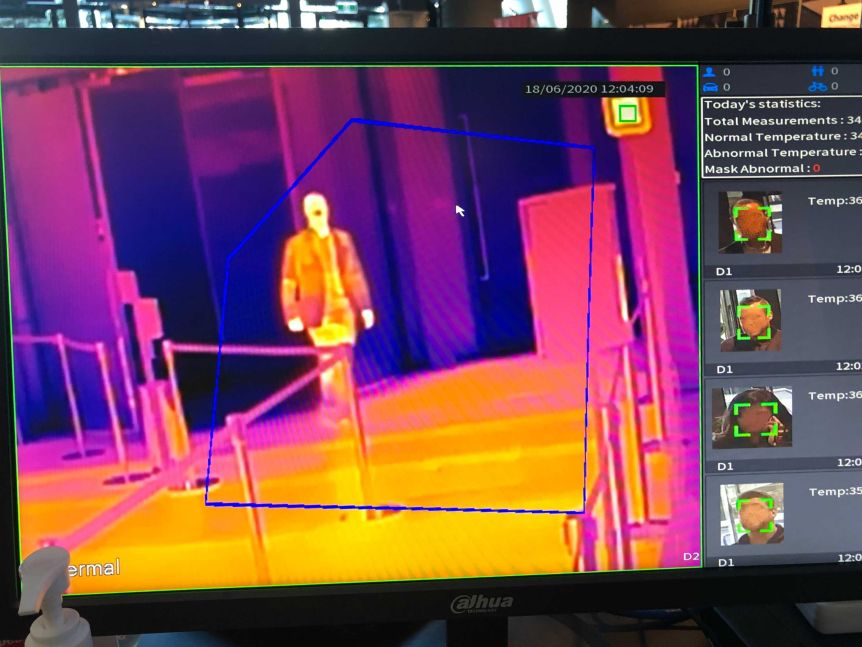
First, there is the hand sanitiser station.
Then, there’s the narrow lane leading past thermal cameras.
If you’re a bit warm from riding or rushing into work — or perhaps something more sinister — you will be taken aside to cool down.
If, after 10 minutes, your temperature hasn’t dropped to 37.5C or below, you will be taken to a dedicated nurse station.
Building access denied.
National Australia Bank’s super-office in the heart of Melbourne’s CBD holds more people than a small town. In normal times it would house more than 6000 people.
But when a worker had a coronavirus scare back in March, the building was evacuated.
The sudden shift to remote working was felt across the country, but for offices in capital cities the move was an enormous — and costly — logistical challenge.
“Many people weren’t working from home when this all hit so we had to upgrade a whole lot of our laptops so they were workable,” NAB chief people officer Susan Ferrier said.

NAB chief people officer Susan Ferrier says staff wellbeing is a priority for NAB. (Photo: ABC News: Madeleine Morris)
“They have been expensive, but on the other hand we have made considerable savings across the organisation.
“Travel has probably more than compensated for the investment we’ve had to make.”
You might like


Currently fewer than 10 per cent of NAB’s office staff are working on site (there are significantly more in branches).
Ferrier said the bank had capacity and procedures in place to accommodate about 20 per cent of office staff returning, and she expected that would last for the next few months.
But NAB’s experience in Melbourne raises a bigger question: what’s the future of the office skyscraper?

NAB’s building is running on skeleton staff at the moment. (Photo: ABC News: Madeleine Morris)
‘Beware choke points’
Many Australian office workers have had a chance to work from home in the last few months, and plenty have developed a taste for it.
A new study found that while most want to return to a physical office after coronavirus restrictions ease, they also want to spend at least part of their working hours at home.
Between 41 to 60 per cent of people surveyed wanted to work two or three days a week from home. Older workers were the keenest.

The survey found that some workers missed office banter with their colleagues during the pandemic. (Photo: Supplied)
This doesn’t surprise Dr Julian Waters-Lynch, a lecturer in innovation and organisational design at RMIT University.
He has studied the rise of remote and co-working spaces over the last two decades, and believes big, central offices will continue to struggle in 2020.
“Part of the reason is choke points,” he said.
“If you’re in a 40-storey building … it’s very hard to get people in there, if you’ve got four elevators, in a way that doesn’t violate social-distancing rules.”
Looking further down the track, Waters-Lynch raises a more blunt philosophical question: what’s the point of the big office?

Centralising workers in cities has all sorts of societal impacts. (Photo: ABC News: Ron Ekkel)
“Designing your organisation to expect 90 per cent of your workforce to be sitting within a few hundred metres of each other in a big space is just not good, for a number of reasons,” he said.
From a hard-headed economic perspective, these buildings are costly assets for companies to hold.
Then there are the societal costs of centralising people in cities, which drives up congestion and house prices as workers vie to live close to work, Waters-Lynch said.
Stay informed, daily
And he doesn’t put much stock in the idea that you need constant face-to-face interactions in a workplace.
“To be frank, it’s either bad, unimaginative managers [who promote this], that either don’t know how to manage people properly or feel they want a sense of control by being able to see people, or it’s just kind of ingrained habit.”
Instead, he argues for a gradual change to more flexible working arrangements, and cites the “hub and spoke” model as one possible solution.
This is the idea that, rather than having thousands of people in one large office, they are instead able to work from home and visit a number of smaller offices run by the company.
These offices, Waters-Lynch says, have the added benefit of being dotted through suburbs or regions, allowing workers to decentralise from cities and have a shorter travel time to work.
“My argument has been to free up the managerial expectation, come together as needed in places that make sense, but don’t expect workers to do it nine to five, five days a week,” he said.
Regional Australia reaping the rewards
In some parts of Australia this move is already under way.
Prue Swain launched Hive, a new co-working space in the regional NSW town of Orange right as the pandemic hit.

It was a bumpy start for Prue Swain, but things are looking up. (Photo: ABC News: Luke Wong)
At first she feared the business was scuppered before it could begin, but as the state successfully flattened the curve her business boomed.
All the permanent offices in the building are now booked and the boardroom and meeting rooms are also booked for this week.
“The whole basis of the concept of this place was to give businesses flexibility,” Swain said.
“We’re very different to the thousands of people working in the one office.”
She has had to make some changes as a result of coronavirus, like converting a 50-person meeting room into smaller offices, but for the most part the model is working.
Swain said Hive was already hosting workers from big companies in the insurance and banking world.
Yet, she also sides with Ferrier from NAB as they both highlight the virtues of face-to-face interaction.
Ferrier says you miss an element of connection when you try to collaborate over phone or video link, and Ms Swain says it’s a simple human desire to be amongst other people.
“We realised that we do need it and want it. We crave it,” Swain said.
“I think COVID was probably a poignant reminder of that.
“I don’t believe everybody will be working from home in the future.”
– ABC / Patrick Wood and Madeleine Morris
Want to see more stories from InDaily Qld in your Google search results?
- Click here to set InDaily Qld as a preferred source.
- Tick the box next to "InDaily Qld". That's it.



