Things to do: Finish writing my book. Graduate high school. Save the world.
Facing COVID-19 and the climate crisis, a high-school student activist offers us a lesson in hope.
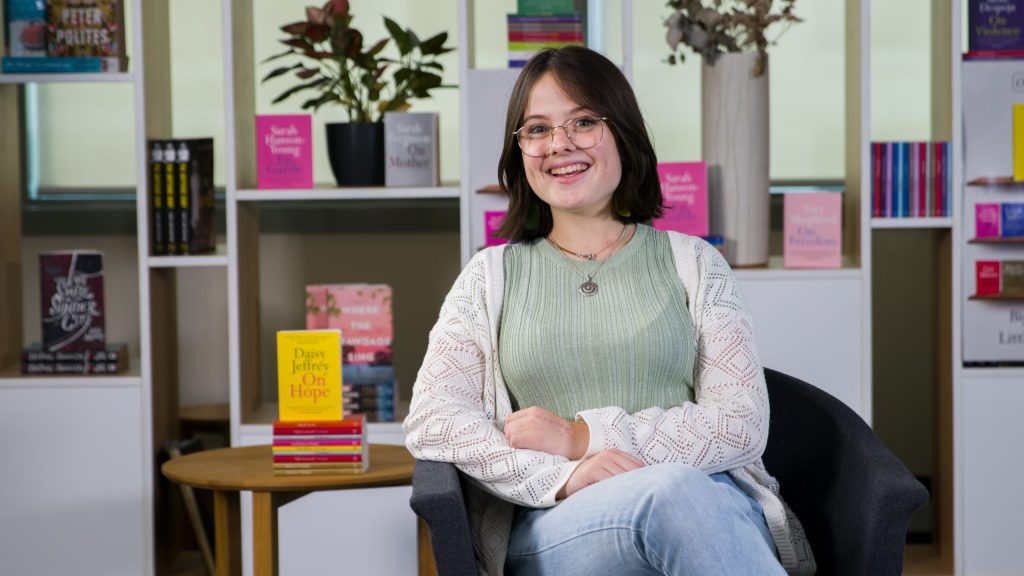
When a promising young leader named Barack Obama introduced himself to the world in the mid-2000s, he did so in part with a book titled The Audacity of Hope.
It was an elegant, compelling title, drawn from the electrifying keynote address he had given to 2004 Democratic National Convention. When it was released in October 2006, The Audacity of Hope swept the bestseller lists; a portent of what was to come when the junior senator from Illinois announced his presidential bid three months later.
But we’re different types here in Australia. More low-key, even self-effacing. And Daisy Jeffrey is just 17 years old. So, when the Sydney-based organiser of the Australian School Strike 4 Climate was approached to publish her first book, a simpler title appealed: On Hope.
Jeffrey’s book – “more of an extended essay,” she chides (what did I say about Australians being self-effacing?) – is a compact 84 pages, the latest addition to the “On …” series, pitched by their publisher as little books on big ideas.
But make no mistake, Jeffrey’s vision is just as audacious as Obama’s. Perhaps even more so.
After all, the man who would become the 44thAmerican president campaigned on a promise to change the United States, endowing it with a positive new vision.
Jeffrey’s campaign vision extends further. Her ambition is to save the world.
You might like


And meanwhile, to pass the HSC.
When I spoke to her this week, Jeffrey was holed up in her bedroom in Sydney’s inner west, contemplating homework and activism, both of which present new challenges in this unfamiliar age of isolation.
“It’s a bit difficult to have hope at the moment, when we’re experiencing two existential crises beside each other, with a climate crisis and a global pandemic,” she admits.
“Activists around the globe right now are trying to work out how to keep targeting climate change. Because we can’t afford to look away. It’s not going away, and Australia is particularly vulnerable, as we saw just last week with the third mass bleaching of the Great Barrier Reef in five years.
“But we know also that people only have the capacity to deal with so much at one time. I know I’m really lucky: I have a great family, I live in a good location and I have great access to the internet. A lot of people I know don’t have the capacity they did before the pandemic, in all sorts of ways. It’s entirely changed the scope of what everybody is doing.”
Jeffrey is particularly concerned that once the federal and state governments ease restrictions to deal with the threat of COVID-19, all talk of climate action will be smothered by the need to restart the economy.
“During summer, we were tens of thousands of people heading out on the streets because they had begun to see the real effects of climate change. They can’t do that [gather together] now …
“And I worry that the government response after this will be: ‘we’re trying to get the economy back working so you can’t talk about this now’. That’s what’s really distressing.”
Stay informed, daily
She confides that she even struggled to start writing her book, after attending the United Nations Climate Conference in Madrid late last year and witnessing rapacious raw power in action.
“There were people in positions of enormous power, who have chosen to turn a blind eye for their own wealth or political [advancement].
“We saw richer countries bullying poorer countries, and they really didn’t want to give indigenous people or younger people a seat at the table. Meanwhile, there was a lot of money revolving through the doors of power, with fossil fuel lobbyists waltzing in and out of government delegations.”
But if there is one thing Jeffrey has learnt over the years since she launched her first green campaign – a blog called The Environmentals – at the age of seven, it is that the only way to maintain hope in the face of fear is to take action.
“If you have a maths exam coming up, and you’ve been studying hard, then it makes sense to say that you hope you’ll do well,” she says.
“But if you haven’t put the work in, just hoping isn’t going to help. The word ‘hope’ is insufficient to achieve a good solution.
“You have to put in the work to keep hope in place.”
On that note, it seems a good time to let her get back to her homework. Did I mention that Jeffrey is a student at the Conservatorium High School, the only specialist music high school in her state?
In between organising rallies of thousands of students, attending international climate conferences and passing maths exams, she plays cello like an angel.
It reminds me that Obama’s title The Audacity of Hope was a reference to a sermon he had once heard, which in turn referenced an English oil painting called Hope. The painting features a blindfolded harpist, perched alone on top of the globe, with just one string remaining in her instrument.
“Her body scarred and bruised and bleeding, her harp all but destroyed and with only one string left, she had the audacity to make music and praise God …” Obama’s former pastor is quoted as saying. “To take the one string you have left and to have the audacity to hope…”
She, too, may feel bruised right now, but Daisy Jeffrey still has many strings to her bow and hope as a backing track. Expect to hear much more from her yet.
Want to see more stories from InDaily Qld in your Google search results?
- Click here to set InDaily Qld as a preferred source.
- Tick the box next to "InDaily Qld". That's it.



