Cutting your fashion footprint is a good look for planet
Australians collectively throw away 600kg of clothing every 10 minutes. But there are some things you can do to make your wardrobe more sustainable.
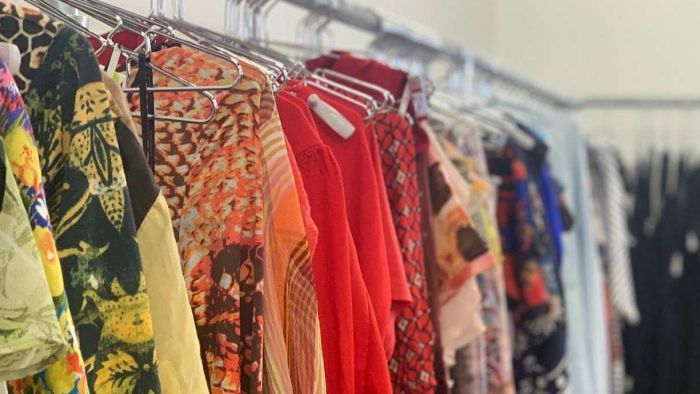
So you’ve bought a reusable coffee cup, remembered to bring your bags to the supermarket almost every time and invested in some beeswax wraps. But have you given a thought to the clothes you’re wearing?
According to the United Nations, the fashion industry is responsible for 8 to 10 per cent of the world’s greenhouse gas emissions.
As a nation, we spend around $5 billion a year on fashion and three-fifths of that is trashed within a year.
Australians collectively send 500,000 tonnes of clothes to landfill each year, which is equal to 600kg thrown away every 10 minutes.
In 2018, fashion stakeholders came together at the UN and created the Fashion Industry Charter for Climate Action, with the aim to achieve zero net emissions by 2050.
But while the top end of the fashion industry is working things out, there are things you can do at home to minimise your fashion pollution.
Look for sustainable fashion
If you are looking for a guilt-free way to add to your closet, it might be time to embrace sustainable fashion.
According to sustainable fashion academic Lisa Heinze, the first step is to check what the garment is made of.
“There’s no silver bullet in terms of what is the best fabric or the most sustainable fabric. Like everything in the world, every material we make has some type of impact,” she said.
“Natural fibres are a better textile to use because there’s fewer chemicals involved in the production of that textile and also it means that the textile can biodegrade at the end of its life.”
You might like


While no natural fibre is perfect — cotton, for example, uses lots of water — synthetic fibres like polyester and acrylic are far worse.
“We’re getting these teeny-tiny fibres coming off while we’re wearing the clothing and while we’re washing the clothing. It gets through filters and ends up in our waterways,” Heinze said.
Clothes made of recycled plastic have the same issue, but Heinze said that was not necessarily a reason to disregard them.
“People are going to continue wearing synthetic fibres in some regard. For instance, activewear uses a lot of synthetic fibres and there’s no natural replacement for what we’ve become used to in that space,” she said.
“So is it better to dig up new petroleum to make that material or is it better to use recycled plastic?
“It’s not quite as straight forward as saying ‘it’s a horrible thing to do’, but it shouldn’t be considered the saviour product that a lot of companies are making it out to be.”
Sustainable fashion looks at the entire lifecycle of the garment — what goes into it, who produces it and where it ends up.
Meaning, it does not come cheap.
“We’re paying the cost that it takes to actually grow and produce a sustainable fibre and importantly we’re paying a fair price to the people who produce the clothing,” Heinze said.
Embrace pre-loved clothing
Second-hand clothing adds to your wardrobe without contributing to the creation of new garments.
At op shops, you can find some very funky pieces for a great price.
But if the idea of sifting through some seriously daggy garments exhausts you, there are always vintage or second-hand clothing shops, which are more like a traditional boutique but full of pre-loved clothing.
They may be a little more pricey, but you are almost guaranteed to fall in love with a garment … or five.
“It’s a really fun way to express yourself and explore your unique style as well as being able to support a more sustainable way of shopping,” said Grace Thalman, the manager of a consignment store in Hobart.
She believes it is time to move away from fast fashion and instead celebrate individuality.”I want to see the end of trends. I don’t think it’s sustainable or necessarily healthy for the world,” she said.
Stay informed, daily
“[Second-hand fashion is] definitely on the rise. It’s expected that in the next 10 years, as an industry, it will exceed the fast fashion industry,” she said.
There are also avenues for those who prefer to shop online.
In Hobart, almost 18,000 people use a Facebook group to buy and sell second-hand clothes.
“It’s a great way to see what’s available locally. So you can go, try it out, make sure you’re happy with it, but also you’re not adding to that fast fashion churn, which we know is destroying our planet,” manager Susannah Slatter said.
Shop your own wardrobe
Before you tap that card, ask yourself, do you actually need new clothes?
As a rule, we tend to wear 20 per cent of our clothes, 80 per cent of the time.
That is where the concept of shopping your own wardrobe comes in.
ABC presenter Tahlea Aualiitia had always considered herself environmentally conscious — she had a reusable cup, drink bottle and tote bag — but her wardrobe was another matter.
“I have items where I look at it and go, ‘I can count on one hand how many times I’ve worn you and yet I’ve had you for maybe five years,’” she said.
She decided to challenge herself to buy no new clothes in 2020 — a journey she’s been documenting on Instagram.
“I haven’t really repeated an outfit yet. So even if I just cycled the three months again, I would only wear these outfits like four times a year,” she said.
“The biggest hurdle has not been putting clothes that I already own on my body, it’s been getting out of that mentality that I need something new to wear.”
It is a sentiment shared by sustainability consultant Jane Milburn.
“Often we’ve got what we already need right there in our wardrobe, but we might have forgotten about it, it’s in the back, we might need a button fixed up,” she said.
Ms Milburn is an advocate of upcycling — adding value by fixing or altering clothes.
“I’ve got things in my wardrobe that have been there for 20 or 30 years. Sometimes I might have to make them a little bigger or a little smaller depending on what’s going on in my life,” she said.
She said people used to upcycle things because resources were scarce, but now they were doing it as a response to excess.
“These are some old-fashioned strategies that are new fashion now. They’re the kind of things that we need to be doing so that we’re not wasting resources,” Milburn said.
Proving everything old can become new again.
– ABC / Lucy MacDonald
Want to see more stories from InDaily Qld in your Google search results?
- Click here to set InDaily Qld as a preferred source.
- Tick the box next to "InDaily Qld". That's it.



